

Is Your Mutual Fund Distribution Website Compliance-Ready?
A mutual fund distributor's website used to be treated like any generic business brochure: a homepage, a few service pages, some mutual fund information, a contact form, a floating WhatsApp button, and an embedded SIP calculator.
In 2026, that approach is becoming increasingly difficult to defend.
For a Mutual Fund Distributor (MFD), your website is not just a marketing channel. It is part of your public-facing commercial communication with retail and HNI investors.
And that creates an essential question every distributor must answer:
Is your website only designed to look professional, or is it also engineered to communicate your regulatory status, investor disclosures, scheme risks, and distribution role accurately?
This matters more in 2026 than ever before.
SEBI's new SEBI (Mutual Funds) Regulations, 2026 came into force on April 1, 2026, replacing the legacy mutual-fund regulatory framework. SEBI also issued an updated Master Circular for Mutual Funds on March 20, 2026. AMFI, meanwhile, issued its consolidated Master Circular for Mutual Fund Distributors on January 14, 2026, followed by SEBI's February 26, 2026 circular on mandatory social-media disclosures.
For MFDs, the practical takeaway is simple:
Your digital presence deserves the exact same compliance rigor as your physical distribution process.
1. What Exactly Is an MFD vs. a Registered Investment Adviser?
A Mutual Fund Distributor is an intermediary involved in selling and distributing mutual fund products to investors, compensated via distribution remuneration from AMCs in accordance with applicable rules.
The distinction between an MFD and a SEBI-registered Investment Adviser (RIA) is strict, non-negotiable, and heavily audited:
Prohibited Nomenclature for MFDs
Under AMFI's Master Circular, an MFD cannot use misleading nomenclature across page titles, domain names, meta descriptions, or website headers, including:
Unless an entity holds an explicit SEBI RIA license, AMFI mandates that the entity clearly identify itself as an "AMFI-registered Mutual Fund Distributor".
This is not a cosmetic wording issue—it ensures investors know exactly who they are dealing with and in what commercial capacity.
2. Why Aesthetic Design Does Not Equal Regulatory Compliance
Imagine an investor searches Google for "Best mutual fund advisor near me".
They visit an MFD website. The hero section reads:
"We are elite experts in wealth management. Earn guaranteed high returns through our top-rated SIPs."
The website looks sleek, loads quickly, and features a glowing "Invest Now" button. But the site fails to clearly disclose:
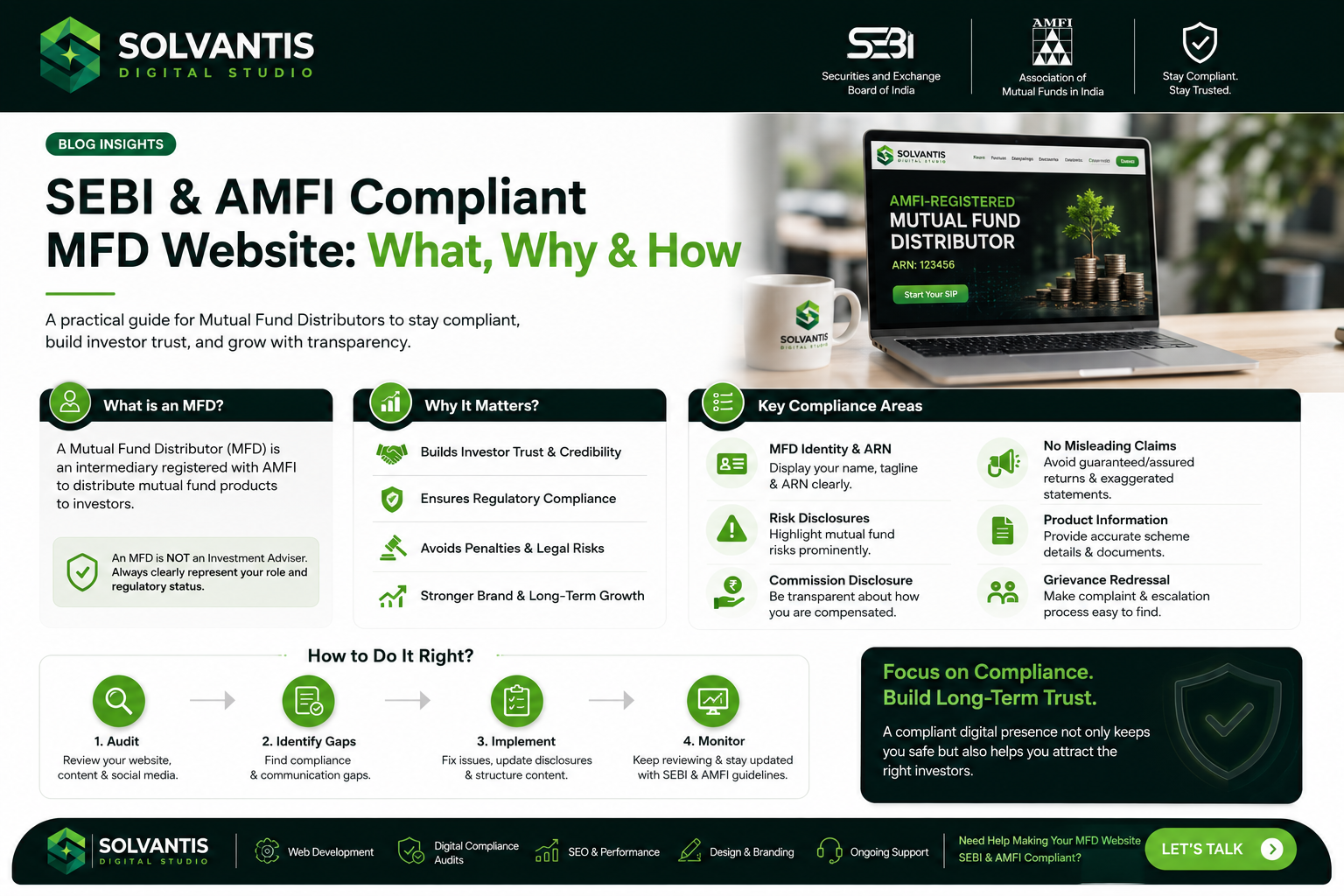
Digital vs Operational MFD Audit
A website can have high performance and still create severe regulatory exposure. Good design does not equal compliant communication.
3. What Changed in the 2026 Regulatory Landscape?
1. SEBI (Mutual Funds) Regulations, 2026
Came into force on April 1, 2026, superseding the legacy framework. SEBI's March 20, 2026 Master Circular consolidated these operational mandates, meaning MFDs can no longer rely on outdated 1996-era compliance checklists.
2. Consolidated AMFI MFD Master Circular (Jan 14, 2026)
Consolidates distributor requirements, requiring mutual fund intermediaries and sales personnel to maintain valid AMFI registrations, NISM certifications, and EUIN mapping for Regular Plan transactions.
3. SEBI Social-Media Disclosure Circular (Feb 26, 2026)
Mandates prominent disclosure of registered legal name, registration category, and ARN across all social media platforms (Instagram, LinkedIn, YouTube, X, Facebook). An MFD's compliance audit can no longer stop at the domain name.
4. First Step: Getting Identity & ARN Prominence Right
AMFI requires the registered distributor name and the tagline:
"AMFI-registered Mutual Fund Distributor"
to be displayed legibly along with the ARN across all communication touchpoints, including headers, footers, about pages, contact screens, mobile layouts, and downloadable PDF reports.
Practical Digital Audit Checklist
5. NISM, ARN, and EUIN: The Operational Backing
A website is only the visible front layer. Behind every compliant website sits an operational distribution structure:
A true compliance audit must check both:
6. Dangerous Words: "Guaranteed", "Assured", and Superlatives

Compliance Red Flags: Superlatives & Guarantees
One of the quickest triggers for regulatory scrutiny is the use of promissory language:
AMFI's Code of Conduct explicitly bars distributors from providing indicative yields or assuring returns.
Responsible vs Promissory Copy
Before publishing any marketing claim or blog post, ask: Can we substantiate this with verified, publicly available benchmark data? If not, do not publish it.
7. Commission & Plan Transparency Builds Investor Trust
Investors frequently ask: How does a mutual fund distributor make money?
An MFD receives distribution remuneration/trail commission from AMCs for investments made under Regular Plans. Rather than hiding this fact in fine print, a modern, high-trust website explains it openly:
"We are an AMFI-registered Mutual Fund Distributor. We receive distribution remuneration from Asset Management Companies for investments routed through our ARN in Regular Plans, in accordance with SEBI and AMFI norms."
Clear compensation disclosure eliminates confusion and reinforces fiduciary integrity.
8. Multi-Channel Compliance: Social Media & WhatsApp
Many distributors maintain a pristine website but publish non-compliant creatives on social channels:
Under SEBI's February 2026 social-media circular, all public digital collateral is held to the same standard:
Website + Instagram + Facebook + LinkedIn + YouTube + Public Broadcasts must all maintain consistent regulatory disclosures and registered identity details.
9. Grievance Redressal: The Hallmark of Trust
A compliant financial website makes it easy for an investor to find support if an issue arises:
10. Step-by-Step MFD Website Audit & Governance Framework
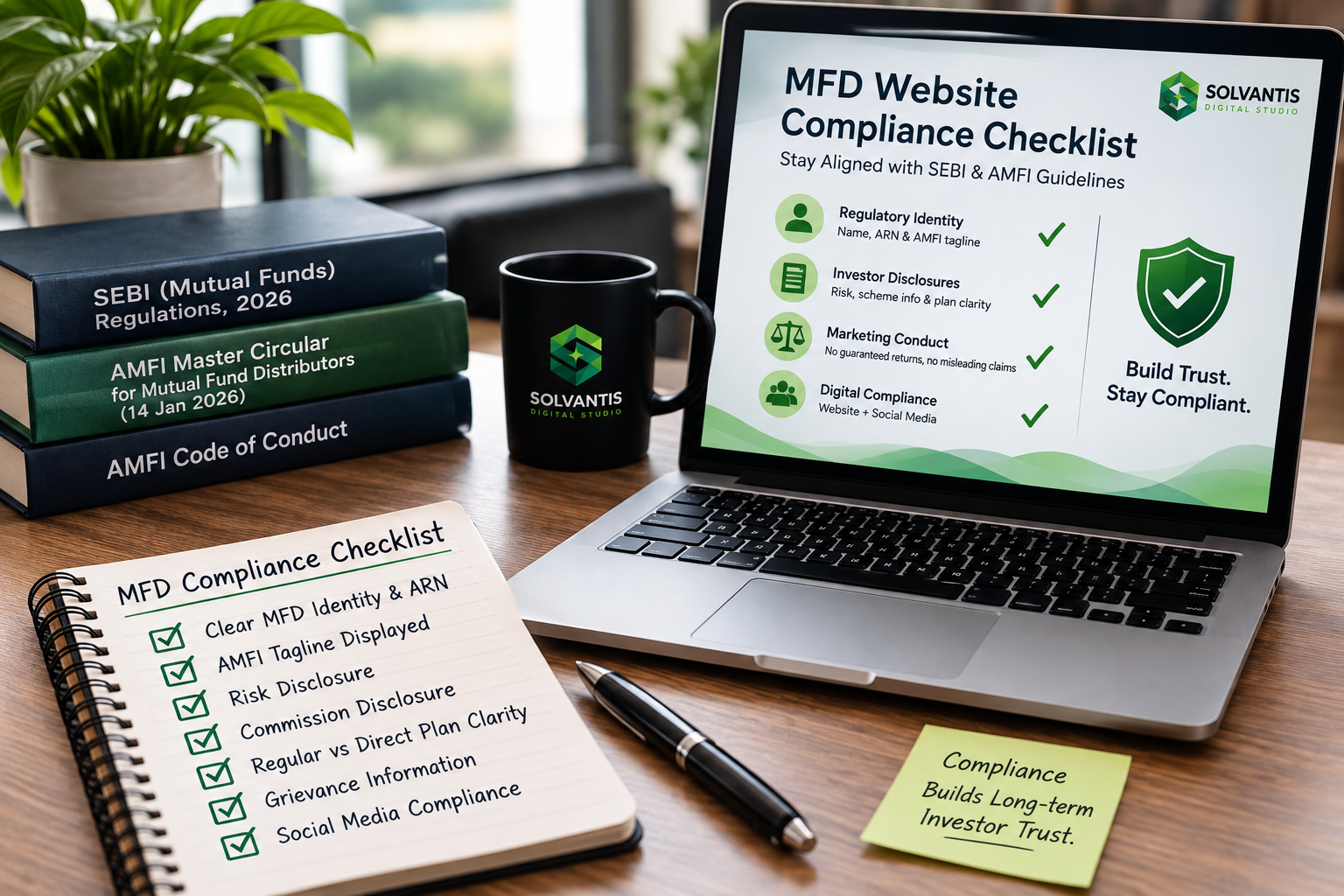
MFD Website Audit & Remediation Framework
To ensure ongoing compliance without sacrificing user experience, follow this 7-step remediation workflow:
Where Solvantis Can Help
At Solvantis, we build modern digital infrastructure specifically engineered for financial services, fintech platforms, and wealth distributors:
Ready to Upgrade Your Digital Compliance?
Ensure your website delivers maximum commercial conversion while meeting 2026 SEBI & AMFI standards.